Restaurant service robots: BellaBot, DinerBot, Servi and ADAM — what they do and what they don't
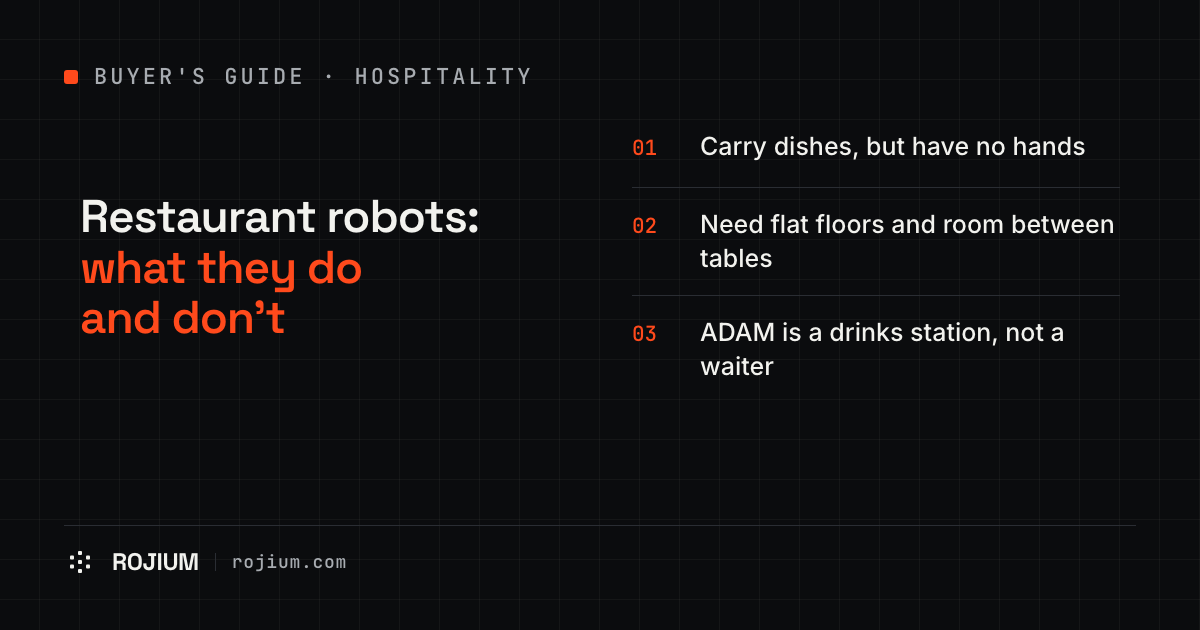
This review is for owners of restaurants, hotels and cafés who are looking at a serving robot. It compares four machines that are often lumped together — Pudu BellaBot, Keenon DinerBot, Bear Robotics Servi Plus and Richtech ADAM — and is mostly about what they cannot do. They carry plates and glasses; they do not serve guests. We treat them as a way to take walking out of a shift, not people out of it.
What we compare and why
Three are tray robots that drive from the kitchen to the table: BellaBot from the Shenzhen maker Pudu, Keenon's DinerBot T9 and T10, and Servi Plus from Bear Robotics, in which LG took a 51% stake in 2025. ADAM is different: a stationary two-armed robot from Richtech Robotics that makes drinks and puts them at a pickup point. Pudu's KettyBot and HolaBot and Keenon's hotel robot ButlerBot W3 are in our hospitality catalogue.
| Robot | Load | Runtime | Narrowest aisle | Steps and slopes | Navigation |
|---|---|---|---|---|---|
| Pudu BellaBot | 4 trays × 10 kg | up to 13 h unloaded | 70 cm | 10 mm, 5° | lidar and visual SLAM |
| Keenon DinerBot T10 | 40 kg | 9–12.5 h | 59 cm | 5°; steps not stated | stereo cameras, visual SLAM |
| Keenon DinerBot T9 | 10 kg per tray, 40 kg | up to 18 h | 70 cm | 5°; steps not stated | not stated |
| Bear Robotics Servi Plus | 2–4 trays × 10 kg | 10–12 h | 65 cm | thresholds up to ½ inch, ramps | not stated |
| Richtech ADAM | two arms, 5 kg each | — | — | — | stationary; up to 60 drinks an hour |
What they do not do
The clearest list comes from operators rather than brochures:
- No handsHiroaki Hanamoto, who led the rollout at Japan's Skylark group, told Impress Watch that BellaBot has no hands, so guests take the dish or staff hand it over.
- Small steps spillA few millimetres at a carpet-to-tile edge jolt the robot: it rolls over, but food topples and liquids spill, he said.
- No stairs, no terracesOrea Hotels in the Czech Republic say the robot needs flat floors without stairs and room between tables; Bear says Servi does not work outdoors.
- Staff still loadPudu's manual forbids taking or placing dishes while the robot moves.
- Network and setupBear says Servi needs high-speed internet and a couple of hours to install.
Measure your aisles and thresholds before a demo. The narrowest passage these makers publish is 59–70 cm, BellaBot's manual allows steps of 10 mm, and a dining room full on a Friday night is not the showroom floor.
What they cost
None of the four makers publishes a price, and we found no public price in Serbia. The dated figures from named sources:
| Robot | Figure | Who said it, when |
|---|---|---|
| Servi | $999 a month in the US, about $2.75 an hour | Bear's COO to Reuters, March 2022 |
| Serving robot, Czech market | about CZK 350,000 to buy, CZK 8,000–15,000 a month to rent | distributor Bettaroe Robotics to Seznam Zprávy, October 2025 |
| ADAM | about $3,500 a month for five years, lease-to-own | Fox5 Las Vegas, February 2024 |
These figures leave out mapping and installation, Wi-Fi coverage, repairs, and the staff time to load and unload. Orea shows both sides of the ledger: at its Horizont hotel in Šumava a robot costs about CZK 14,000–15,000 a month, covers 60–80 km and pays off; at the Pyramida in Prague it does not, because it cannot reach every table.
What each robot does, and where it stops
Pudu BellaBot
Four 10 kg trays, up to 13 hours unloaded, a 4.5-hour charge, lidar and visual navigation and 0.5–1.2 m/s. The newer BellaBot Pro passes 65 cm aisles and runs 11 hours.
The largest documented fleet is Skylark's: about 3,000 BellaBots in some 2,100 Gusto, Bamiyan, Jonathan's and Shabuyo restaurants by December 2022. Skylark reported 7.5% higher lunch-peak turnover at Gusto, 35% less clearing time and 42% fewer steps for staff, the operator's own figures.
Limits: indoor, flat and dry floors only, 10 mm steps at most, a 70 cm aisle.
Keenon DinerBot T9 and T10
Both carry 40 kg. The T10 navigates by four stereo cameras and visual SLAM, needs a 59 cm aisle and runs 9–12.5 hours; the T9 takes 10 kg per tray, needs 70 cm and runs up to 18 hours.
We found no independently reported deployment with figures for either model.
Limits: Keenon's pages give no threshold height, so ask for it in writing.
Bear Robotics Servi Plus
Two to four 10 kg trays, 10–12 hours, a 65 cm aisle, ramps and thresholds up to half an inch, and charging by dock or cable.
Bear said in 2022 it had shipped more than 5,000 Servi robots, with Denny's and Chili's among its partners. Chili's tested a Bear robot called Rita in 61 restaurants and stopped in August 2022: AP reported that it moved too slowly and got in the way of servers, and 58% of guests surveyed said it did not improve their experience.
Limits: no outdoor use, and it depends on a fast network.
Richtech ADAM
ADAM does not go to tables. Its two arms prepare drinks from preset recipes, up to 60 an hour, and place them at pickup, while staff restock and clean.
Richtech names Clouffee & Tea in Las Vegas, where ADAM has made more than 16,000 drinks, and Globe Life Field in Arlington. In May 2026 a café at Đure Jakšića 4 in Belgrade opened with what Kurir called Serbia's first robot barista; the maker was not named.
Limits: one station and one task, with an arm span of about two metres to fit behind the counter.
Against wages in Serbian hospitality
In July 2026 the average net wage in food and beverage service was 72,819 dinars, against a national average of 121,346, according to Statistical Office data reported by Novosti. The minimum wage is 371 dinars net per hour in 2026 and is set at 405 for 2027. Staff are scarce too: Infostud puts hospitality among the sectors with the biggest shortages, and the HORES association says 5,000–10,000 young hospitality workers leave Serbia every summer, while foreign hires work mostly in kitchens because of the language barrier.
That is the honest case for a robot: it takes over the carrying, not the service. Compare its monthly cost with the walking and clearing hours it removes, not with a waiter's salary.
Who it suits and who it does not
Long runs from the kitchen on a flat floor: the profile where Skylark measured its gains.
Clearing dirty plates is where Skylark saw 35%; a bussing robot such as HolaBot targets it.
Not a fit: stairs, high thresholds and outdoor floors are outside every specification here.
An ADAM-type station: a different investment from a tray robot.
What to ask the supplier
- What is the narrowest aisle and highest threshold the robot passes when loaded?
- Who maps the venue, how long does it take, and what Wi-Fi does it need?
- What happens when the network drops during service?
- Does the monthly fee cover repairs, batteries and a replacement unit?
- Who services it in Serbia, and how fast? Our origin checklist covers the questions about who really makes it.
- Will a unit delivered after 20 January 2027 have documents under the new Machinery Regulation?
What we did not check
We tested none of these robots, and every specification is the maker's. We found no public price in Serbia, no official Serbian distributor for Pudu, Keenon or Bear, and no reported tray-robot deployment in a Serbian restaurant.
Sources
- Pudu — BellaBot
- Pudu — BellaBot user manual
- Keenon — DinerBot T10
- Keenon — DinerBot T9
- Bear Robotics — Servi Plus
- Richtech Robotics — ADAM
- Impress Watch, May 2023 — Skylark and BellaBot
- Business Insider Japan, April 2023 — Skylark
- Reuters via Euronews, March 2022 — Bear Robotics
- AP via Fortune, April 2023 — Robot servers
- Seznam Zprávy, October 2025 — Robot waiters
- Fox5 Las Vegas, February 2024 — ADAM
- Kurir, May 2026 — Robot barista in Belgrade
- Novosti, September 2026 — Wages by activity
- Biznis.rs, May 2026 — Seasonal worker shortage
Turn the use case into a machine list.
Describe the site, payload and timeline. Rojium will map suitable hardware and service options.
Robot showcase
Compare the first catalogue machines.
Open the robot showcase to review pilots by vertical, use case and request-only commercial terms.
Related articles
Unitree's first quarterly report since listing: what the figures tell buyers
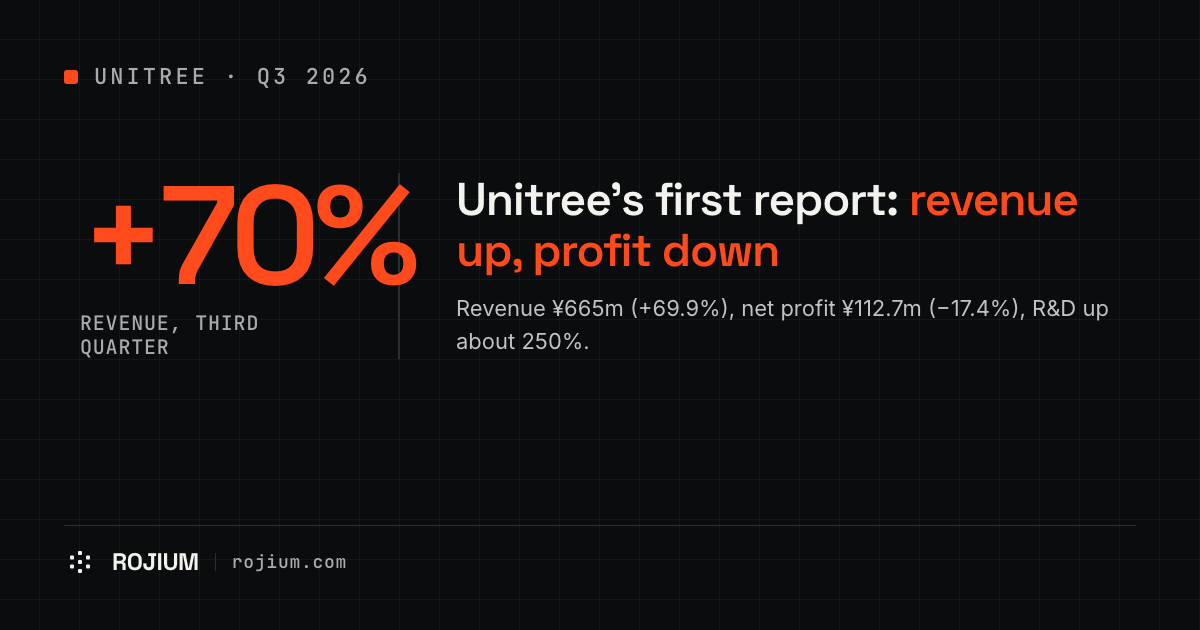
Revenue up 70%, profit down 17%, R&D up about 250%, inventory nearly tripled — and no unit numbers. What Unitree's first report since its Shanghai listing tells a buyer in Europe.
Robot floor scrubbers for a shopping centre: Neo 2, T7AMR, Scrubber 50, KIRA B 50 and what the monthly bill covers
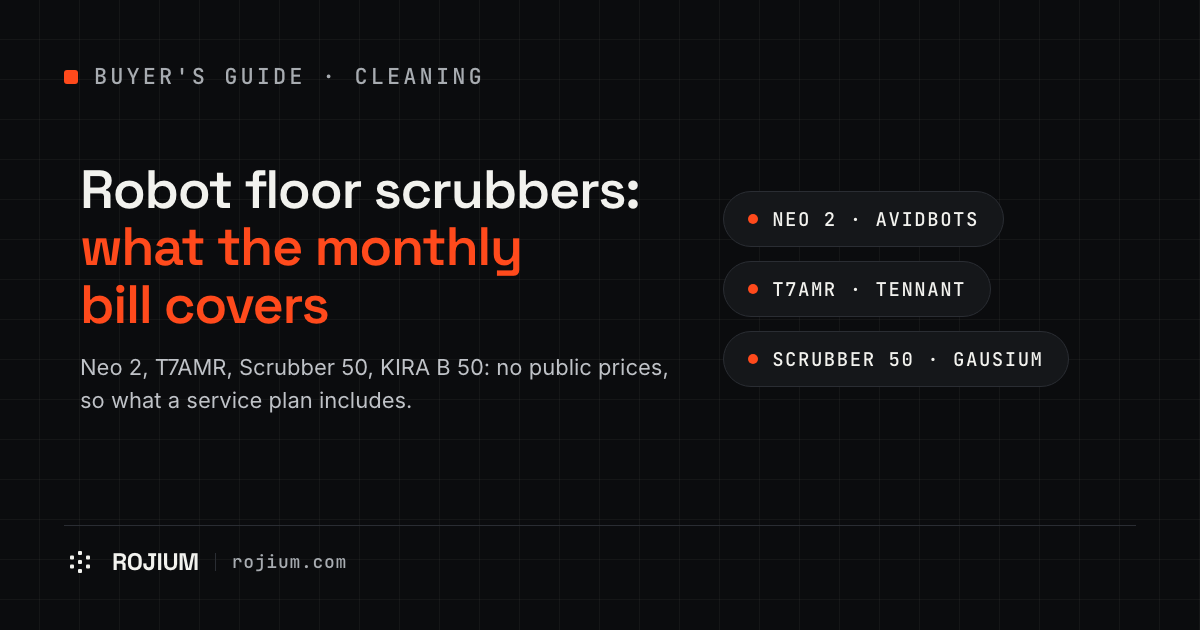
Four autonomous scrubber-dryers for malls, airports and hospitals compared on published specs, and what goes into the monthly bill when no maker publishes a price.
World Robotics 2026: what the IFR's numbers say about Europe
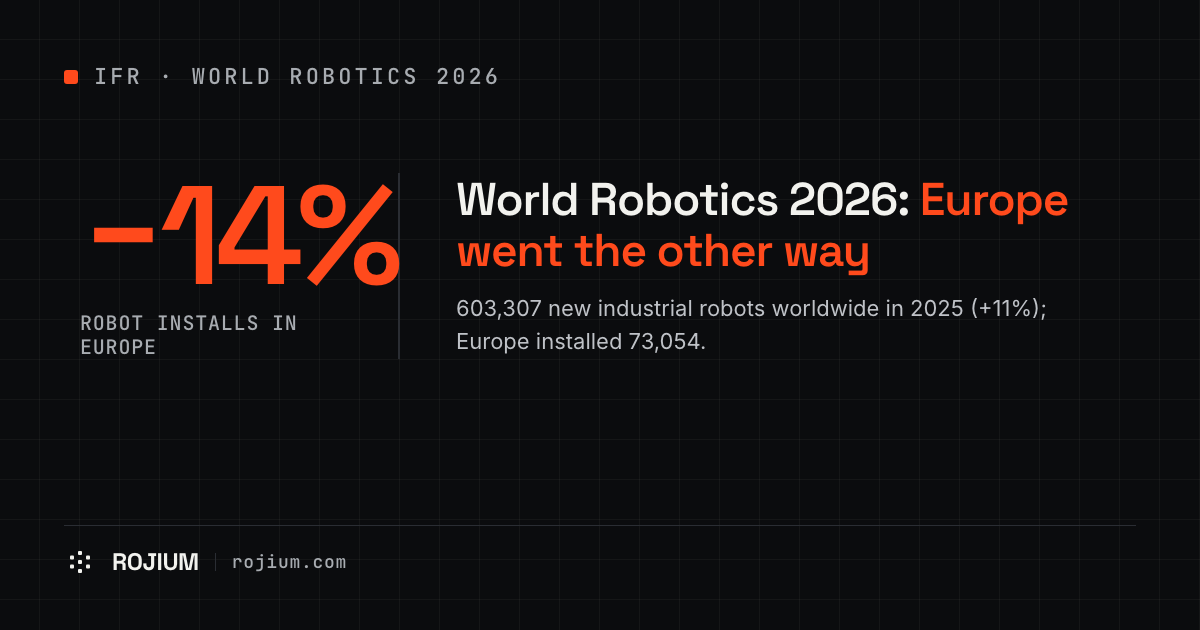
The IFR counted 603,307 new industrial robots worldwide in 2025. Europe installed 14% fewer, Asia took 76%, and humanoids are still a pilot-scale market. What the data does and doesn't say about Serbia.