World Robotics 2026: what the IFR's numbers say about Europe
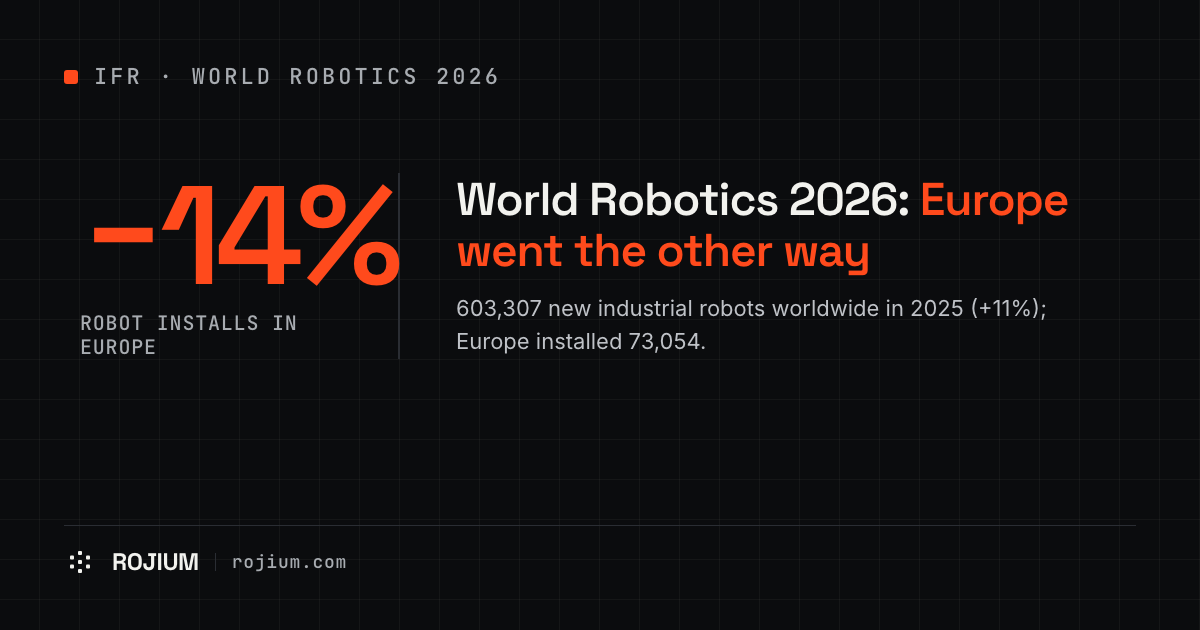
On 24 September the International Federation of Robotics (IFR) published World Robotics 2026, its annual count of industrial robots, with data for 2025. Worldwide installations rose 11% to a record 603,307 units, and the number of robots working in factories passed five million (5,079,078). Europe moved the other way.
Europe in 2025: down while Asia and the Americas grew
| Market | Installations in 2025 | Change vs 2024 |
|---|---|---|
| World | 603,307 | +11% |
| Asia | 457,315 | +14% |
| Europe | 73,054 | −14% |
| European Union (EU-27) | 60,500 | −11% |
| Germany | 24,800 | −8% |
| Americas | 57,044 | +14% |
For comparison, last year's World Robotics 2025 put Europe at about 85,000 installations in 2024. Asia's share of new robots rose from 74% to 76%. The IFR points to weak demand from the automotive industry: in the EU, car makers installed 14,900 robots, 25% fewer than a year earlier, and remain the largest customer. The installed base kept growing, and the EU passed 700,000 operating robots (712,000). For Europe the IFR expects no growth in 2026 and about 6% a year from 2027 to 2029.
Humanoids: a market counted in thousands
The report's executive summary is direct: “Most humanoids remain prototypes or pilot-stage technologies rather than industrial-grade products.” For production tasks, it adds, industrial robots are economically superior at the current stage of technology.
Where Serbia fits
Serbia does not appear in the materials the IFR made public on 24 September: the press releases, the executive summary and the press-conference slides. Country tables are in the paid report, and we do not fill the gap with press estimates.
The numbers still give a sense of scale for the Šabac plant. Different speakers have put its capacity at 1,000–2,000, 3,000 and “more than 5,000” robots a year (our report from the line). Even the lowest figure equals about a seventh of all full-size humanoids the IFR counted as sold worldwide in 2025. The comparison is approximate: the IFR counts only humanoids taller than 140 cm, while Šabac also builds a 130 cm model and four-legged robots. These are targets; shipments from Šabac have not been published.
The IFR also notes that the first Chinese robot suppliers have set up European distribution hubs, and that trade restrictions in other markets, such as the United States, may strengthen the trend (our piece on the US rule).
What an integrator can take from this
- A flat 2026The IFR forecasts zero growth for Europe this year; in its outlook, growth returns from 2027.
- Local presenceAccording to the IFR, regionalisation raises the importance of local engineering, system integration, service and support for robot suppliers.
- Humanoids as pilotsNearly 7,000 humanoids against 603,307 industrial robots: treat humanoid offers as pilot projects with clear acceptance criteria.
Sources
Turn the use case into a machine list.
Describe the site, payload and timeline. Rojium will map suitable hardware and service options.
Robot showcase
Compare the first catalogue machines.
Open the robot showcase to review pilots by vertical, use case and request-only commercial terms.
Related articles
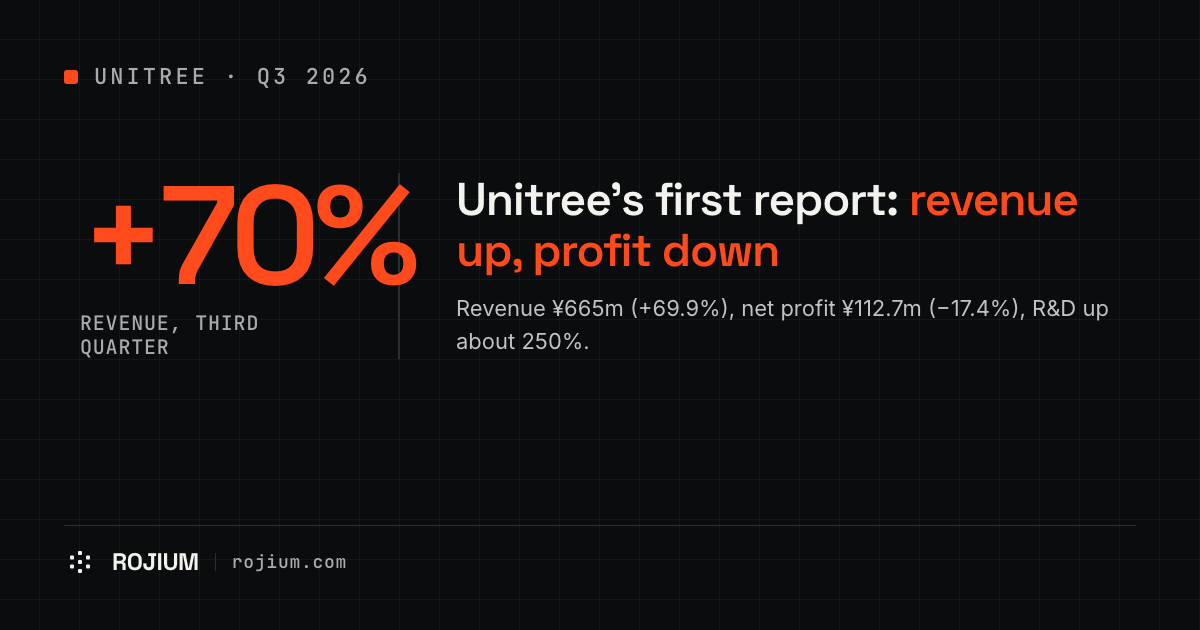
Unitree's first quarterly report since listing: what the figures tell buyers
Revenue up 70%, profit down 17%, R&D up about 250%, inventory nearly tripled — and no unit numbers. What Unitree's first report since its Shanghai listing tells a buyer in Europe.
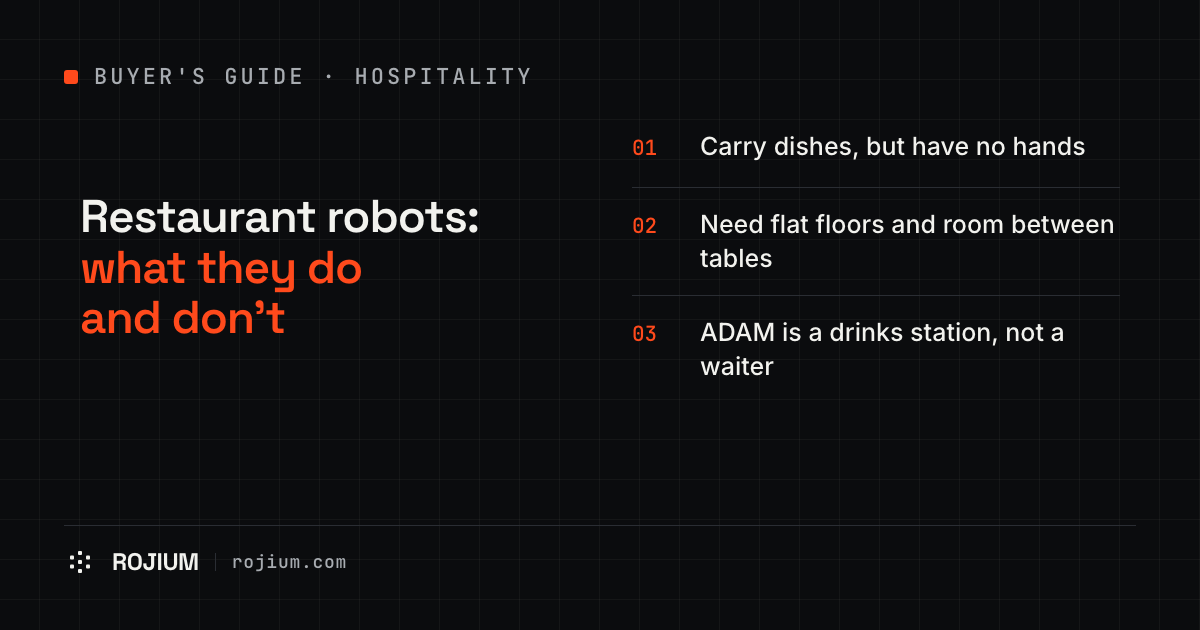
Restaurant service robots: BellaBot, DinerBot, Servi and ADAM — what they do and what they don't
Four robots sold to restaurants, hotels and cafés compared on published specs: what they carry, what they cannot do, what operators measured and what the few public prices say.

Robot floor scrubbers for a shopping centre: Neo 2, T7AMR, Scrubber 50, KIRA B 50 and what the monthly bill covers
Four autonomous scrubber-dryers for malls, airports and hospitals compared on published specs, and what goes into the monthly bill when no maker publishes a price.