Inside the Šabac line: two robot sizes, and a capacity number that keeps moving
 B
BFive days after Minth’s Šabac plant opened, on 3 September 2026, Serbian public broadcaster RTS filmed the actual assembly line and came back with numbers the opening ceremony had skipped: two humanoid sizes, a production supervisor who spent a month training in China, and a capacity figure lower than the one President Vučić had given less than a week earlier. None of that makes the factory less real — it just makes “how big is this” harder to answer with one number.
Two sizes, one line, no model names
RTS described two humanoid models coming off the Šabac line: one 173 cm tall and weighing 55 kg, the other 130 cm and 35 kg, plus four-legged “robot dogs.” Neither RTS nor Minth named a specific model. Informer’s report from opening day, 29 August, had already used the manufacturer’s own category language for the pair — “full-size” and “half-size” humanoid — the terms AGIBOT itself uses for its A2 and X2 lines.
That terminology, together with the dimensions, points to catalogue hardware rather than a Serbia-specific design. AGIBOT’s February 2026 Munich launch showed a full-size A2 humanoid, a compact X2 humanoid and a D1 quadruped line — the same three categories described in Šabac. Published specifications for those families put a standard A2 at roughly 175 cm and 55 kg and the X2 at about 131 cm and 35 kg, close to what RTS measured. AGIBOT’s current spec sheet also lists a heavier “Ultra” A2 variant at 169 cm and 69 kg — a reminder that even one manufacturer’s numbers for the same product name move around. The quadruped wasn’t sized in the report; AGIBOT’s own D1 family spans machines from 15.5 kg to versions rated for a 50 kg payload, so it can’t be matched to a specific version either.
What “assembly” looks like on the floor
RTS’s description of the actual work is narrow: hundreds of sensors let the robot sense its surroundings, and motors and joints let it move. Production supervisor Dejan Babić’s job, as RTS describes it, is quality control — making sure components are connected correctly. Babić trained for 30 days at what he called a “factory of the future” in Jiaxing, China (rendered “Đasing” in Serbian coverage), where, in his own words, he “attended trial production processes and logistics operations.” Chinese specialists work the line alongside local staff and engineers. RTS also reported plans to expand the workforce to more than 200 people, without giving today’s headcount. RTS reports that robots leave the line as general-purpose units; software and AI assign each one to a specific job only afterward, depending on where it will be deployed.
That is consistent with what RFE/RL was told, and not told, at the opening: Vučić said Šabac would “assemble, and later produce,” but RFE/RL got no answer from the Serbian government, Minth or AGIBOT on what “production” means at this stage, or how much of a robot is actually made, rather than fitted together, in Serbia. An AI manager quoted on the line, Miljan Radunović, offered a goal instead of a number: “It’s not enough to just assemble robots. We need to extract the knowledge from it.” He added that “the European market, which demands strict standards, will be a particular challenge,” and warned that “a factory that looks one way today can change drastically in three or six months.” Aspiration is not an answer to the question RFE/RL actually asked.
Four capacity numbers, four speakers, no reconciliation
- 1,000–2,000 a year — Finance Minister Siniša Mali, 30 May, before the plant existed.
- “More than 5,000 a year” — President Vučić at the 29 August opening, phrased as a hope: “I hope we’ll assemble, and later produce, more than 5,000 robots a year in Šabac” (one outlet transcribed it as 6,000; four others agree on “more than 5,000”).
- 3,000 a year — general director Jin Mao, in the 3 September RTS report: “the planned capacity of the factory is 3,000 robots a year,” aimed mainly at the European market.
- Up to 20,000 a year — also announced 29 August, but for something much bigger: “once the project is complete,” Tanjug quoted, referring to Šabac plus the planned €200 million robotics park in Inđija, which hasn’t broken ground. No completion year was given.
Set aside the 20,000 figure, which openly describes a bigger, unbuilt project rather than Šabac today. Even so, Šabac’s own capacity claim came in three different numbers in just over three months: 1,000–2,000 before the plant opened, “more than 5,000” as a presidential hope on opening day, 3,000 as the plant’s own general director’s stated plan five days later. Nobody has reconciled the three figures, and none of them describes robots that have actually shipped — that number, the only one an integrator could check, hasn’t been published.
What this means for a buyer
For an integrator or reseller sizing up Šabac as a supplier, the RTS report answers a narrower question than “how big is this”: the hardware is very likely AGIBOT’s existing A2, X2 and D1 catalogue rather than a bespoke platform, and Serbian assembly today means connecting components and quality-checking them, with task logic added afterward in software. It doesn’t say which of the four capacity numbers will hold, how many robots actually shipped in 2026, or what share of a robot’s parts will ever be made, rather than assembled, in Serbia. Those remain open questions worth putting to Minth and AGIBOT directly, not settled facts to repeat from a press event.
Sources
- RTS — Šabac deo nove industrijske mape sveta – prvi roboti sišli sa proizvodne trake
- RTS — Iz fabrike u Šapcu izaći će humanoidni roboti i roboti koji se kreću na četiri noge – koje će poslove preuzeti
- Informer — Istorijski dan za Srbiju: Ovo su svi detalji o prvoj fabrici humanoidnih robota u Evropi
- Tanjug — Vučić na otvaranju fabrike robota u Šapcu
- AGIBOT — A2 product specifications
- AGIBOT — X2 product specifications
- AGIBOT — D1 Pro product specifications
Turn the use case into a machine list.
Describe the site, payload and timeline. Rojium will map suitable hardware and service options.
Robot showcase
Compare the first catalogue machines.
Open the robot showcase to review pilots by vertical, use case and request-only commercial terms.
Related articles
BAGIBOT's TÜV Rheinland certificates: what they cover, what they don't
AGIBOT left IFA Berlin with TÜV Rheinland certification for the A3 Ultra and a European distribution deal with Tekpoint. Here's what RED DA, RED NB and Safety AK actually test — and what a Serbian buyer still needs to ask for.
AGIBOT named as the company behind the Šabac robot factory
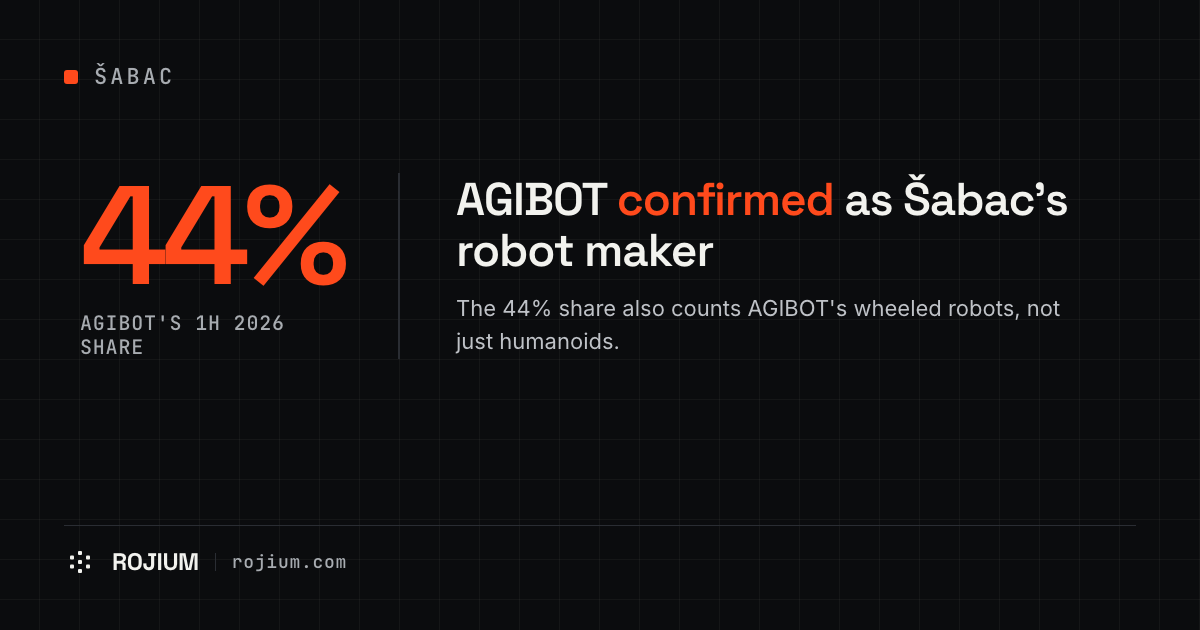
Serbia's trade minister said on 12 August that AGIBOT will open the Šabac humanoid-robot factory with Minth at the end of August. Behind the 'world leader' label are first-half figures that also count wheeled robots.
BQuadruped vs humanoid: which robot actually pays off on a warehouse floor
We ran a quadruped inspection unit and a humanoid picking unit side by side for 30 days on the same warehouse floor. Here's what actually moved the cost-per-task number.