AGIBOT's TÜV Rheinland certificates: what they cover, what they don't
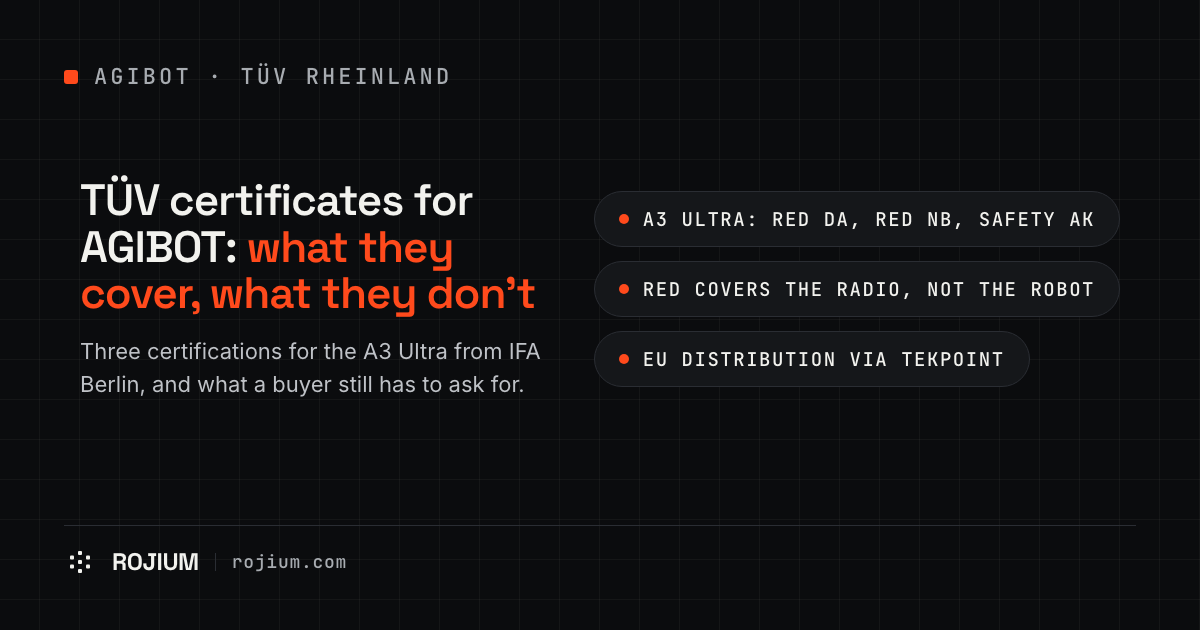
From 4 to 8 September 2026, AGIBOT held a stand at IFA Berlin (H25-371, Hall 25) built around its A3 flagship — a 173 cm, 55 kg humanoid demonstrating reception, retail and multilingual interaction. Alongside the hardware, the company announced two things that matter more to a buyer than the demo: TÜV Rheinland certification for the A3 Ultra, and a distribution alliance with Tekpoint in Europe. Neither is as sweeping as the headlines suggest.
What was actually certified
TÜV Rheinland — a German testing house that also operates as an EU notified body for several product categories — awarded the A3 Ultra three certifications: RED DA, RED NB and Safety AK. AGIBOT’s own release adds that A2, X2, G2, D1 Max Pro and C5 were tested too, calling them “certified”; independent trade press covering the same event used the more cautious “subjected to joint testing protocols,” without saying which certificate each model got. Worth remembering when a sales deck claims the whole range is “TÜV-certified.”
RED DA and RED NB: the radio module, not the robot
RED is the EU’s Radio Equipment Directive (2014/53/EU) — it applies to any device with a radio module (Wi-Fi, Bluetooth, cellular) sold in the EU. “DA” points to the 2022 Delegated Act on cybersecurity, mandatory since August 2025: it covers protecting networks, personal data and users from fraud on internet-connectable devices. “NB” most plausibly means a notified body, not the manufacturer’s own self-declaration, carried out the assessment. Either way, RED certification concerns the robot’s wireless connectivity and cybersecurity behaviour. It says nothing about how the arms move, how much force they apply, or what happens if a joint fails.
Safety AK: one safety function, not the whole robot
“AK” most likely refers to Anforderungsklasse — a German requirement-class scale (AK1 to AK6) for safety-related control systems, broadly comparable to today’s SIL or Performance Level ratings. Neither AGIBOT nor TÜV Rheinland’s public materials say which class the A3 Ultra achieved, or which safety function was tested — an emergency stop, torque limiting, collision detection, or something else. A “Safety AK” badge proves one safety-related function passed a real test — not that the whole robot is certified safe to work around people.
What’s still missing: machinery conformity
Neither AGIBOT’s IFA announcement nor the A3 Ultra’s product page, which lists “EU CE (RED, safety, RoHS, etc.)” and other approvals, names the EU’s Machinery Directive, or its replacement, Regulation (EU) 2023/1230. That regulation becomes fully binding only from 20 January 2027, and it explicitly extends essential safety requirements to autonomous mobile machinery and AI modules performing safety functions — precisely the category a general-purpose humanoid falls into. Nothing found says the A3 Ultra carries that conformity assessment for the complete machine — only for its radio module and one safety function.
What to request before buying
- The actual TÜV Rheinland certificates — number, scope, and the exact model or batch they cover — not just the marketing claim.
- Which safety function the Safety AK certificate tested, and at what class.
- A written statement on Machinery Directive conformity today, and on the plan for Regulation (EU) 2023/1230 from 2027 — for the complete robot, not only the radio module.
- Who handles service and spare parts locally: AGIBOT directly, its Šabac partner, or Tekpoint — which, per its own site, already has an office in Serbia, though neither company said the IFA deal covers Serbia specifically.
Sources
- AGIBOT — AGIBOT Showcases Embodied AI Robots in Action at IFA 2026
- Humanoids Daily — AGIBOT Deepens European Push at IFA 2026 with TÜV Rheinland Certification and Tekpoint Retail Alliance
- AGIBOT — A3 Ultra product page (certifications FAQ)
- Tekpoint — About
- EU-OSHA — Regulation (EU) 2023/1230 on machinery
Turn the use case into a machine list.
Describe the site, payload and timeline. Rojium will map suitable hardware and service options.
Robot showcase
Compare the first catalogue machines.
Open the robot showcase to review pilots by vertical, use case and request-only commercial terms.
Related articles

Robots instead of herbicide: FD20, LaserWeeder and ARA on Vojvodina's row crops, and what Orio's exit teaches
Three ways to weed row crops without blanket spraying, compared on maker data and a German cost study, plus what IPARD III says and what happened to Naïo's Orio.
Mowing slopes with no one on them: remote-controlled mowers compared
Six radio-controlled slope mowers side by side: stated slope and what it hides, weight and transport, what the law requires when the link drops, and what such a machine costs and saves.
Robot dogs for plant inspection: Spot, ANYmal D, X30 and B2 compared
Four quadrupeds sold for industrial inspection, side by side: what each does on a round, where it is documented at work, its limits, and what ownership costs beyond the robot.