Different flag, same robot? A buyer’s checklist for robots sold under a local brand
In early September, Arthur Bellamy, chief revenue officer of the French warehouse-robot maker Exotec, argued that the FCC’s new rules on foreign robots could give Chinese suppliers a bigger opening in Europe — some of them arriving under a European brand instead of their own. In the same statement he added: “it is too early to say that they will lead to a significant increase in Chinese competition in Europe.” This article keeps both halves: a mechanism worth checking a contract against, and a caveat that it is not yet a trend.
The rule itself, adopted on 28 July, is covered in our earlier piece, and the legal test of what counts as Serbian- or Chinese-made in the rules-of-origin article. What is new here is the route in — and what a buyer can do about it.
What Exotec said, and who is saying it
The statement ran in trade media in early September (FORWARDER magazine dates it 2 September, Logistics Business 9 September). Exotec builds warehouse robots itself, so this is a market participant’s view, not a regulator’s finding or an independent study. Three points carry it:
- The routeHow a Chinese-made system can reach European buyers under a European name.
- The caveatExotec itself adds that it is too early to say the rules will lead to a significant increase in Chinese competition in Europe.
- The askBetter tools to judge suppliers, and safeguards for products that fall short.
The route is the core of the claim. Presented “through a recognised European brand or integrator,” a solution “can be perceived by customers as European offerings, even when the underlying technology, manufacturing origin, ownership and value creation remain predominantly Chinese.” His car example is Stellantis and Leapmotor, whose partnership sells Chinese-made Leapmotor cars through Stellantis’s European dealers (Yahoo Finance, February 2026). Those cars keep the Leapmotor name; the closer analogy for robots is the warehouse-automation catalogue, where a Chinese-made system can carry a European integrator’s name.
The same statement says the FCC measures “do not create an immediate disruption to the sale, operation or support of currently authorised European robotic systems in the United States.” For Europe it calls for “stronger tools to assess subsidies, ownership, supply-chain transparency and product origin” and, for products that “cannot demonstrate adequate security, transparency or fair competitive conditions,” “targeted procurement safeguards or restrictions on market access.”
The logistics catalogues he mentions belong to other companies; we could not check that claim independently and do not name them. The outlets we could read carry the same Exotec text, so it counts as one source, not three.
Why the label does not settle it
EU product law makes it easy to sell another company’s design under your own name. Under the Machinery Regulation, which applies from January 2027, the manufacturer is whoever makes a product — or has it designed or made — and markets it under their own name or trademark. So the name on the EU declaration of conformity shows who answers for the robot in the EU, not who designed it or where it was built. The importer of a product made outside the EU must put its own name and postal address on it — or, where that is not possible, on the packaging or an accompanying document: a second name to look for. None of this is improper; it is the rule. The trouble starts only when the label is the whole answer.
Six questions before you sign
Bellamy’s dimensions — technology, origin, ownership, value creation, transparency — translate into questions a buyer or integrator can put to a supplier in writing. The dimensions are his; the questions are Rojium’s, and this is not a legal test.
| Ask | What it tells you | Where to look |
|---|---|---|
| Who designed the platform, and who controls its software? | Technology origin — the part a local label does not show | Datasheet, software licence, update terms; the named developer of the base platform |
| Where is it built, and what work is done in Europe? | Manufacturing origin — assembly is not the same as legal origin (rules of origin) | Nameplate and production-site address; a written description of the local work |
| Who owns the supplier and its group? | Ownership | Company-registry extract; group structure in the annual accounts |
| Who is the legal manufacturer, and who is the importer? | Who answers for the robot in the EU — possibly a brand that did not design it | EU declaration of conformity; importer’s name and address on the product |
| What share of the component cost is European, and which modules are not? | Value creation and supply-chain transparency. The US test: domestic components above 65% of component cost; we found no comparable EU threshold for robots | A written breakdown by origin for the compute unit, actuators, battery and firmware |
| What will it cost over its life, and who provides service here? | Exotec’s warning: “What appears to be a saving at the point of purchase can become a much larger economic cost over time.” | Written terms: spare-parts location, software-update policy, response times, end-of-support date |
The data question — where the robot’s data goes and who can push updates to it — belongs on the same list; our piece on the FCC rule sets it out.
How to read the answers
None of the questions has a single right answer. A Chinese platform sold under a local brand is not illegal, and a supplier that says plainly “the platform is Chinese, final assembly is in Serbia, the importer is named in full” is easier to deal with than one that offers only reassurances. What should worry a buyer is an answer that is vague, verbal or missing: a supplier that cannot say in writing who designed the robot or what share of it is built in Europe cannot back up the word “European” on the label either.
One more layer: the supply chain runs both ways
On 24 July China’s Ministry of Commerce put 14 EU entities on its export-control list, a day after the EU’s 21st sanctions package against Russia named 14 companies from mainland China and Hong Kong. Chinese exporters may not supply the listed entities with dual-use items. One of the 14 is Garnet S.r.l., an Italian maker of rare-earth permanent magnets and components for automation, robotics and the automotive sector (Il Foglio). None of the reports we read says what the listing means for robot supply chains, so it is not evidence of a trend. It is here for one reason: what goes into a supplier’s robot can become a trade-policy question from either side, which is why the question about component cost is not academic.
What we’ll watch
Whether a Chinese humanoid or robot-dog maker names a European brand or integrator as its route to market — the mechanism Bellamy describes would then be visible in robots, not only in cars and warehouse catalogues — and whether the EU builds the assessment tools he asks for.
Sources
- FORWARDER magazine — US foreign-made robotics crackdown could give Chinese suppliers a bigger opening in Europe, says Exotec
- Logistics Business — U.S. Foreign-made Robotics Rules Impact Europe
- Yahoo Finance — Stellantis weighs broader Leapmotor EV tech tie-up for Europe
- EUR-Lex — Regulation (EU) 2023/1230 on machinery
- Il Foglio — China has added two Italian companies to its blacklist in response to EU sanctions against Russia
- Global Times — China blacklists 14 EU entities under export controls
- TASS — China adds 14 EU companies to export control list in response to 21st sanctions package
- OSW — China hits Europe’s defence industry in response to the EU’s 21st sanctions package
Turn the use case into a machine list.
Describe the site, payload and timeline. Rojium will map suitable hardware and service options.
Robot showcase
Compare the first catalogue machines.
Open the robot showcase to review pilots by vertical, use case and request-only commercial terms.
Related articles
Boston Dynamics' weapons ban covers ICE too - the platform behind Serbia's armed robot dogs has no published policy
On 9 September Boston Dynamics confirmed to Boston.com that its weapons ban covers every customer, ICE included. Four days later Serbia put armed robot dogs on a live-fire range - built by a manufacturer nobody has named, under a policy nobody has published.
 C
CArmed robot dogs: from a promise to the proving ground in two weeks
On 13 September Serbia showed armed robot dogs in public for the first time, fulfilling a promise made two weeks earlier. Confirmed: the weapons and the task. Not confirmed: who made them.
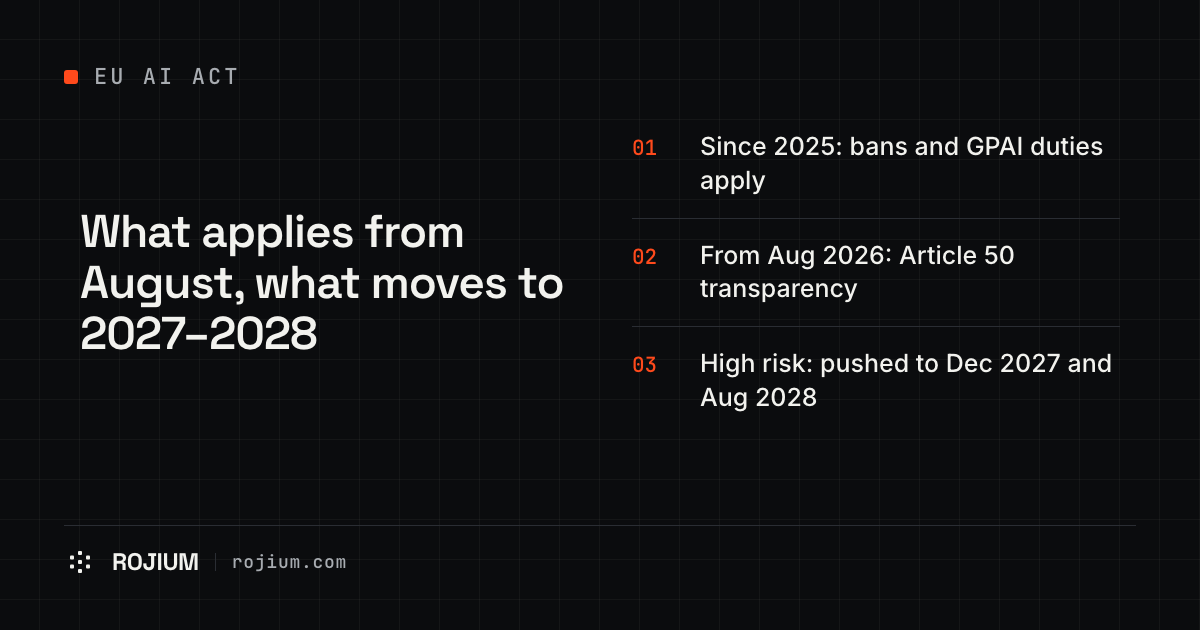
EU AI Act: what applies from 2 August and what moved to 2027–2028
The AI Act's general application date arrived on 2 August 2026, but days earlier the Digital Omnibus pushed the high-risk rules to December 2027 and August 2028 — and sent AI in machinery, robots included, down a separate route.