EU AI Act: what applies from 2 August and what moved to 2027–2028
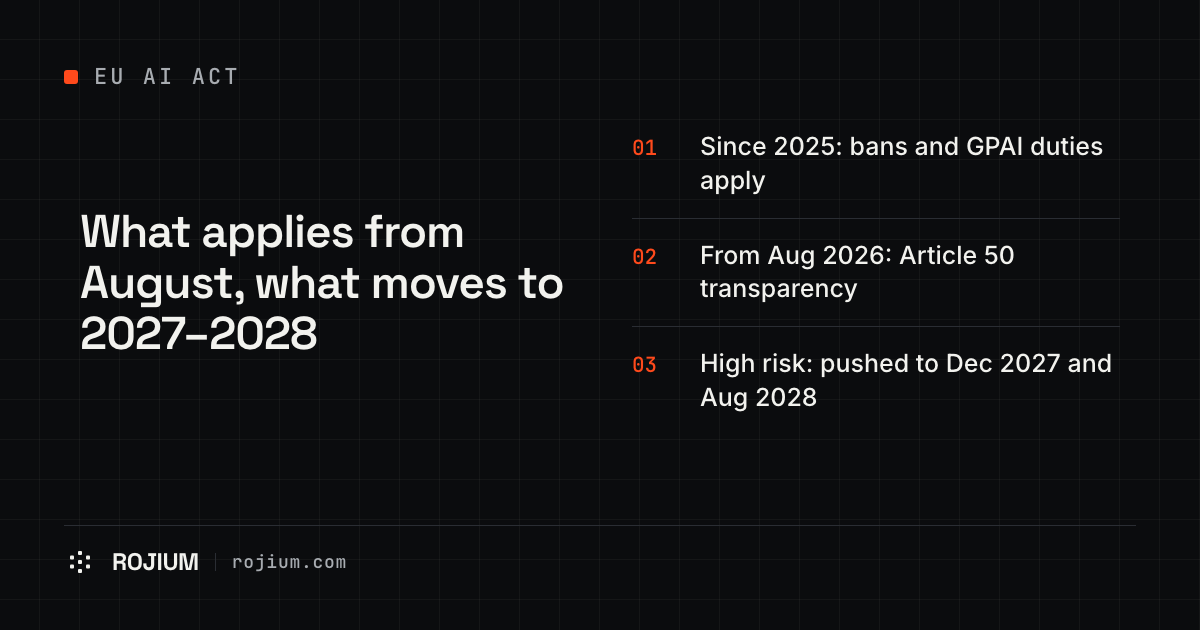
2 August 2026 was the date from which most of the EU Artificial Intelligence Act was due to apply. Less changed than that date once promised. Six days earlier, on 27 July, the Digital Omnibus on AI — Regulation (EU) 2026/1744 — entered into force and moved the high-risk rules to 2 December 2027 for stand-alone use cases and to 2 August 2028 for AI in regulated products. For machinery, robots included, it went further: the AI Act's high-risk requirements will no longer apply to it directly. What did start on 2 August are the transparency duties of Article 50.
Dates at a glance
- Since 2 February 2025: prohibited AI practices (Article 5) and the AI literacy duty (Article 4).
- Since 2 August 2025: obligations for providers of general-purpose AI models, governance and the penalty provisions, except fines on those model providers.
- From 2 August 2026: transparency duties (Article 50) and the Commission's power to fine providers of general-purpose AI models.
- 2 December 2026: end of the grace period for machine-readable marking of AI-generated content by systems already on the market.
- 2 December 2027: high-risk rules for stand-alone systems listed in Annex III.
- 2 August 2028: high-risk rules for AI in products listed in Section A of Annex I.
What was already in force
Two duties matter for robotics. The first is the list of prohibited practices. For machines with cameras the key one is this: AI systems that infer the emotions of people at the workplace or in education institutions are banned, unless they are intended for medical or safety reasons. A robot or camera system that reads workers' moods on the shop floor falls under the ban unless it serves one of those two purposes. Breaches of the prohibitions carry fines of up to €35 million or 7% of worldwide annual turnover, whichever is higher.
The second is AI literacy. The Omnibus rewrote it: providers and deployers must support the development of AI literacy among their staff, without having to guarantee any specific level.
Since August 2025, providers of general-purpose AI models — such as the large language models behind voice interfaces — have had to give documentation to the companies that build those models into their own systems. If a robot runs on such a model, that documentation is the integrator's starting point.
What started on 2 August 2026
Article 50 covers four situations:
- AI that talks to people. Providers must design systems that interact directly with people so that those people are informed they are dealing with AI, unless that is obvious. For robotics this concerns any robot that holds a conversation — at a reception desk, in a shop or in a hotel; whether the machine's appearance alone makes it obvious depends on the context.
- AI-generated content. Providers of systems that generate audio, images, video or text must mark the output in a machine-readable format. Systems placed on the market before 2 August have until 2 December 2026.
- Emotion recognition and biometric categorisation. Deployers must inform the people exposed to such systems — where the systems are allowed at all.
- Deepfakes. Deployers must disclose that the content has been artificially generated or manipulated.
The Commission published its final guidelines on Article 50 on 20 July. The duties are supervised by national market surveillance authorities, and by the Commission's AI Office where the same company develops both a general-purpose model and the system built on it. Breaches can be fined up to €15 million or 3% of worldwide annual turnover, whichever is higher; for SMEs, whichever is lower.
What moved to 2027 and 2028
This is a postponement, not a cancellation. The requirements — risk management, technical documentation, human oversight, the duties of importers and distributors of high-risk systems — stay in the law; the dates moved.
- Annex III, stand-alone high-risk use cases: 2 December 2027 instead of 2 August 2026. Relevant to logistics and industry: systems that allocate tasks based on individual behaviour or personal traits, or monitor and evaluate the performance of workers, and AI used as a safety component in managing road traffic or the supply of water, gas, heating or electricity.
- Annex I, Section A, AI as a safety component of regulated products: 2 August 2028 instead of 2 August 2027. Section A still covers toys, lifts, radio equipment and medical devices. Where AI performs a safety function in such a product and the product needs third-party conformity assessment, the AI Act's high-risk rules apply from 2028.
The Omnibus also narrowed what counts as a safety component. AI used only for user assistance, performance optimisation, efficiency, automation, convenience or quality control unrelated to safety is not one — unless its failure or malfunction would endanger health or safety. A route optimiser in a fleet of warehouse robots is a different case from the vision system that stops a robot before it hits a person.
Robots and machinery: a separate route
For machinery the Omnibus did more than shift a date. It moved the Machinery Regulation (EU) 2023/1230 from Section A to Section B of Annex I. For products under Section B, the AI Act's high-risk requirements do not apply directly: only a few provisions apply, among them the classification rule and the articles amending sectoral laws. Instead, the Commission is empowered to write AI-specific health and safety requirements into the Machinery Regulation itself through delegated acts.
That does not leave robots unregulated. The Machinery Regulation applies from 20 January 2027 and already treats two AI cases as high-risk machinery: safety components with fully or partially self-evolving behaviour using machine learning that ensure safety functions, and machines with such embedded systems. Both require third-party conformity assessment. For a mobile robot whose safety function relies on self-evolving machine learning, the date to plan around is therefore January 2027 under machinery law, not 2028 under the AI Act. The details for buyers are in our overview of the Machinery Regulation.
The carve-out concerns the high-risk rules for AI that ensures safety. A robot's voice interface, for example, is not a safety component: Article 50 applies to it as to any other AI system that talks to people.
What importers and integrators should do now
The AI Act does not ask where a robot was made — unlike the US rule of 28 July. It applies to providers placing AI systems on the EU market wherever they are established, to importers and distributors, to manufacturers who place a product with an AI system on the market under their own name, and to providers and deployers outside the EU whose system's output is used in the EU. A Serbian integrator delivering to a customer in the EU is in scope. A robot bought and used only in Serbia is outside the AI Act's own scope; which Serbian rules apply to it is a separate question this article does not cover.
- Voice or chat interface: ask the supplier how the robot tells people they are talking to AI.
- Generated speech, images or text: ask how the output is marked and by when.
- Cameras that analyse people: make sure emotion recognition is not used on workers, other than for medical or safety reasons; wherever it is used, people must be informed.
- A general-purpose model inside: request the model provider's documentation for integrators.
- Deliveries into the EU from 2027: check the conformity route under the Machinery Regulation, including third-party assessment for self-evolving safety functions.
What we'll watch
The Commission's final guidelines on classifying high-risk AI systems — the drafts were published in May and the consultation closed on 23 July; the delegated acts that will write AI requirements into the Machinery Regulation; and how national authorities start supervising Article 50 in the months before the marking grace period ends on 2 December.
Sources
- EUR-Lex — Regulation (EU) 2026/1744 (Digital Omnibus on AI)
- AI Act Explorer — Implementation timeline
- AI Act Explorer — Article 50: Transparency obligations
- Gibson Dunn — EU AI Act Omnibus Agreement: postponed high-risk deadlines
- Freshfields — EU AI Act unpacked #34: The final Digital Omnibus on AI
- Reed Smith — Code of Practice adequacy and final Article 50 guidelines
- EU-OSHA — Regulation (EU) 2023/1230 on machinery
Turn the use case into a machine list.
Describe the site, payload and timeline. Rojium will map suitable hardware and service options.
Robot showcase
Compare the first catalogue machines.
Open the robot showcase to review pilots by vertical, use case and request-only commercial terms.
Related articles
Boston Dynamics' weapons ban covers ICE too - the platform behind Serbia's armed robot dogs has no published policy
On 9 September Boston Dynamics confirmed to Boston.com that its weapons ban covers every customer, ICE included. Four days later Serbia put armed robot dogs on a live-fire range - built by a manufacturer nobody has named, under a policy nobody has published.
Different flag, same robot? A buyer’s checklist for robots sold under a local brand
A French robot maker warns that Chinese suppliers could reach Europe under local brands — and calls it too early to say they will. Six questions that separate a European robot from a European label.
 C
CArmed robot dogs: from a promise to the proving ground in two weeks
On 13 September Serbia showed armed robot dogs in public for the first time, fulfilling a promise made two weeks earlier. Confirmed: the weapons and the task. Not confirmed: who made them.