A robot dog without a standard: which rules apply to walking machines in 2026
Anyone buying a four-legged inspection robot or a humanoid in October 2026 runs into the same gap: there is no published safety standard written for machines that must actively balance to stay upright. The one being prepared, ISO 25785-1, is a committee draft. Its comment period closed on 8 July 2026, and ISO has not announced a publication date. This article sets out what exists, what is still a draft, and what integrators, industrial customers and public buyers can require from a supplier, and write into a contract, until the standard is out.
What exists: ISO 10218 in its 2025 edition
In February 2025 ISO published new editions of ISO 10218-1 and ISO 10218-2, the core safety standards for industrial robots and their first major revision since 2011. Part 1 treats the robot as partly completed machinery and sets requirements for its design. Part 2 covers integration into applications and cells. Trade press noted that the revision makes functional safety requirements explicit rather than implied, folds in the collaborative-application requirements of ISO/TS 15066 and adds cybersecurity requirements related to robot safety.
The revision does not solve the walking problem. As Tech Briefs summarised in May 2025, ISO 10218 covers industrial robots, while “existing standards, however, don't cover safety of humanoid robots.” Wheeled autonomous mobile robots and automated guided vehicles have ISO 3691-4:2023 on driverless industrial trucks. A legged robot fits neither document cleanly.
Why a walking machine is a separate case
The draft defines the category itself: robots that need active control to remain balanced and could become unstable without power, such as quadrupeds, bipeds and wheeled balancing robots. That is where a familiar safety logic breaks. Aaron Prather of ASTM International told MIT Technology Review in June 2025: “In traditional robotics, if something happens, you hit the little red button, it kills the power, it stops.” A humanoid cut off the same way, he added, will likely fall.
Makers describe a controlled transition instead. Agility Robotics CTO Pras Velagapudi said that after a stop signal the robot “basically has a fixed amount of time to try to get itself into a safe state.” Federico Vicentini, head of product safety at Boston Dynamics, who chairs the ISO working group, put the approach this way: “We want to standardize the goal, not the way to get to the goal.”
Where ISO 25785-1 stands
The full title reads: Robotics — Safety requirements for dynamically stable industrial mobile robots (legged, wheeled, or other forms of locomotion) — Part 1: Robots. Tech Briefs describes it as a type-C standard, that is, one written for a specific kind of machine. Its life cycle on the ISO catalogue page:
- 8 May 2026
- Committee draft registered (stage 30.00)
- 12 May 2026
- Consultation on the committee draft opened (30.20)
- 8 July 2026
- Comment period closed (30.60); next comes either referral back to the working group or registration as a draft international standard
- Publication
- No date announced
The scope covers industrial workplaces where the public is excluded or restricted. Robots that are ridden or worn, road vehicles, floor-cleaning robots and robots for non-industrial settings are out; for non-industrial mobile robots the draft points to ISO 13482. Integration into applications is left to a Part 2, to be developed separately. The European committee CEN/TC 310 approved a parallel project, prEN ISO 25785-1, on 9 January 2026, and the Institute for Standardization of Serbia approved its national adoption project, prSRPS EN ISO 25785-1, on the same date.
No robot can be certified to ISO 25785-1 yet: the text is a draft and may still change. If an offer cites it, ask which version, what was tested against it, and by whom.
What to require from a supplier now
Without a product standard, a buyer can still ask for the documents that existing machinery rules and general standards already provide for:
| Request | Basis | What to look for |
|---|---|---|
| Risk assessment of the complete machine | ISO 12100 | Falls, loss of power, stairs and slopes, people nearby, behaviour after a stop |
| Safety functions with a rated level | ISO 13849-1 (PL) or IEC 62061 (SIL) | Which functions are rated, such as emergency and protective stops or speed limits, and to what level |
| Applicable parts of ISO 10218:2025 | ISO 10218-1 and -2 | For robots with an arm: which clauses were applied and which the supplier considers not applicable |
| EU declaration of conformity | Directive 2006/42/EC, plus EMC and radio rules | It covers the complete machine, not only its radio module |
| Statement on 2027 | Regulation (EU) 2023/1230 | A written plan for units delivered from 20 January 2027 |
This level of documentation exists on the market. ANYbotics' 2022 specification sheet for ANYmal D states that the emergency stop on the robot disconnects the complete power supply and complies with ISO 13849-1:2015, Category 3, PL c, and lists CE marking under the Machinery Directive together with the EMC, Low Voltage, Radio Equipment and RoHS directives. Every supplier can be asked for the same detail, and for what the robot does physically when the stop is pressed. The opposite case, certificates covering a radio module and one safety function, is analysed in our article on AGIBOT's TÜV certificates.
What to write into the contract
- Standard-change clause If ISO 25785-1 is published during the contract, the supplier delivers a gap analysis and, where needed, an updated risk assessment.
- Acceptance on your site Stops, stairs, slopes and behaviour near people tested on your route against criteria agreed in advance.
- Software updates A change to locomotion or safety software comes with a statement on whether the risk assessment still holds.
- Operating area Use limited to industrial areas without public access, in line with the draft's scope, unless agreed otherwise in writing.
- Documentation date The date of the declaration of conformity and the act it refers to, for deliveries close to 20 January 2027.
The Serbian side
In Serbia, machinery is placed on the market under the Rulebook on Machinery Safety (Pravilnik o bezbednosti mašina, Official Gazette RS 58/2016 and 21/2020), which states that it is harmonised with the principles and essential requirements of Directive 2006/42/EC. A supplier selling into Serbia should therefore be able to provide the same set of documents. What the EU's new Machinery Regulation changes for buyers here is covered in our earlier overview.
What we'll watch
The next entry on the ISO page: referral of the draft back to the working group, or its registration as a draft international standard, which opens a wider ballot. Buyers still weighing classes of machine for a warehouse can start with quadruped versus humanoid.
Sources
- ISO — ISO/CD 25785-1
- ISO — ISO 10218-1:2025
- ISO — ISO 10218-2:2025
- Control Design, February 2025 — ISO 10218 update
- Tech Briefs, May 2025 — Setting the standard for humanoid robots
- MIT Technology Review, June 2025 — Why humanoid robots need their own safety rules
- Institute for Standardization of Serbia — prSRPS EN ISO 25785-1
- ANYbotics, 2022 — ANYmal D technical specifications
- EU-OSHA — Regulation (EU) 2023/1230 on machinery
- Pravilnik o bezbednosti mašina, Sl. glasnik RS 58/2016, 21/2020
Turn the use case into a machine list.
Describe the site, payload and timeline. Rojium will map suitable hardware and service options.
Robot showcase
Compare the first catalogue machines.
Open the robot showcase to review pilots by vertical, use case and request-only commercial terms.
Related articles
Boston Dynamics' weapons ban covers ICE too - the platform behind Serbia's armed robot dogs has no published policy
On 9 September Boston Dynamics confirmed to Boston.com that its weapons ban covers every customer, ICE included. Four days later Serbia put armed robot dogs on a live-fire range - built by a manufacturer nobody has named, under a policy nobody has published.
Different flag, same robot? A buyer’s checklist for robots sold under a local brand
A French robot maker warns that Chinese suppliers could reach Europe under local brands — and calls it too early to say they will. Six questions that separate a European robot from a European label.
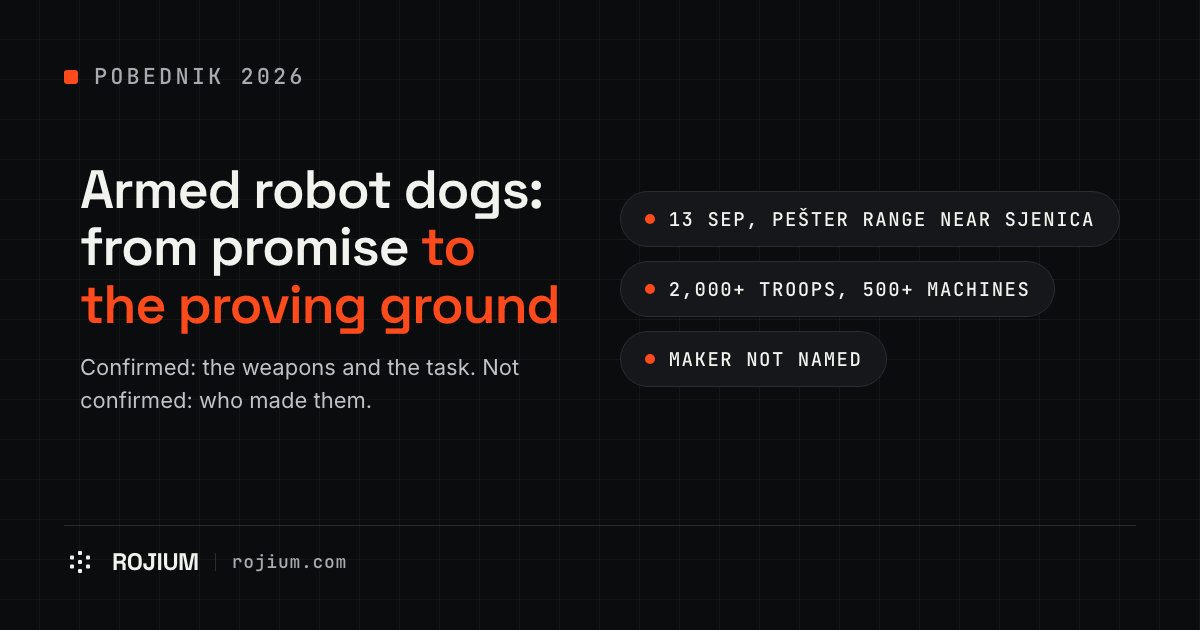
Armed robot dogs: from a promise to the proving ground in two weeks
On 13 September Serbia showed armed robot dogs in public for the first time, fulfilling a promise made two weeks earlier. Confirmed: the weapons and the task. Not confirmed: who made them.