What's actually made in Serbia: the mechanics, not the mind
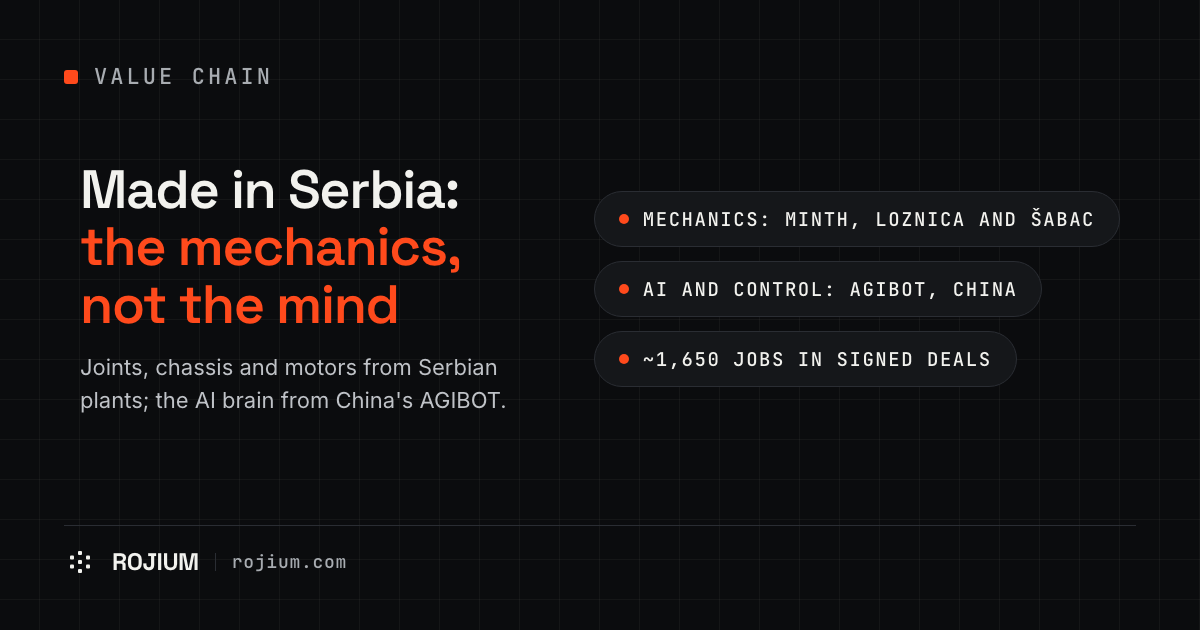
Strip the announcements down to their engineering and Serbia's robot project has a clear seam. The mechanical body — joints, chassis, motors, battery housings — is to be built in Serbian plants; the AI “brain” and algorithms come from China's AGIBOT. Where that seam sits decides how much of the value actually stays in the country.
The division of labour
- Made in Serbia: mechanical components and assembly, plus battery housings and some software, through Minth's operations in Loznica and Šabac.
- From China: the embodied-AI models and control software from AGIBOT.
- Jobs: the project is described as creating on the order of 8,000 positions across the wider high-tech push — a headline figure worth separating from the ~1,650 jobs tied to the specific signed investments.
Minth is not a newcomer: reporting puts its Serbian workforce at around 3,500 across facilities operating since 2018. That existing base is precisely why the mechanical side is credible — this is an established parts manufacturer extending into a new product, not a factory conjured from nothing.
The value-capture question
Assembling bodies while importing the intelligence is a normal way to enter a hardware industry — it is roughly how consumer electronics manufacturing began in much of Asia. The open question is whether Serbia moves up from bending metal toward the higher-margin parts — actuators, control electronics, and eventually the AI itself — or stays a mechanical subcontractor to a Chinese platform. The first is an industry; the second is a payroll.
Why it matters for buyers
For anyone sourcing hardware in the region, the split is practical, not academic: local mechanical production can shorten lead times and simplify service and spares, even when the software stack is foreign. Rojium flags where regional assembly genuinely changes availability — and where a “made in Serbia” label mostly means final assembly.
Sources
Turn the use case into a machine list.
Describe the site, payload and timeline. Rojium will map suitable hardware and service options.
Robot showcase
Compare the first catalogue machines.
Open the robot showcase to review pilots by vertical, use case and request-only commercial terms.
Related articles

Robots instead of herbicide: FD20, LaserWeeder and ARA on Vojvodina's row crops, and what Orio's exit teaches
Three ways to weed row crops without blanket spraying, compared on maker data and a German cost study, plus what IPARD III says and what happened to Naïo's Orio.
Mowing slopes with no one on them: remote-controlled mowers compared
Six radio-controlled slope mowers side by side: stated slope and what it hides, weight and transport, what the law requires when the link drops, and what such a machine costs and saves.
Robot dogs for plant inspection: Spot, ANYmal D, X30 and B2 compared
Four quadrupeds sold for industrial inspection, side by side: what each does on a round, where it is documented at work, its limits, and what ownership costs beyond the robot.