Belgrade emerges as the EU's nearshore robotics assembly hub
 A
AThree final-assembly lines for autonomous ground systems opened in the Belgrade metropolitan area over the last two quarters. None of them existed eighteen months ago. Taken together with Serbia's EU candidate-country customs arrangements, the region is starting to look less like an emerging market story and more like a logistics decision manufacturers are making on spreadsheets.
Why Belgrade, why now
Labor cost is part of the story, but not the whole of it. Engineering wages in Belgrade have risen close to 20% year-on-year, which narrows the gap with Poland and Czechia that manufacturers relied on a decade ago. What has not narrowed is the customs treatment: components entering Serbia for assembly and re-export into the EU move under simplified transit rules that Rojium's logistics partners describe as materially faster than equivalent routes through non-EU Balkan states further south.
- Skilled labor pool. Three technical universities in Belgrade and Novi Sad graduate a combined ~1,400 mechatronics and robotics engineers per year.
- EU candidate status. Simplified customs transit for components moving toward final EU destinations.
- Time zone and language. CET alignment and widespread English/German fluency reduce coordination overhead with EU-based design teams.
The Belgrade–EU logistics corridor
The practical effect shows up in lead times. A quadruped or arm assembled in Belgrade and destined for a buyer in Germany or Austria typically clears the corridor in under 48 hours of road transit, compared with 5–7 days for the same unit shipped from manufacturing hubs in East Asia. For operators who need to replace a failed unit on an active site, that difference is the whole business case.
We used to quote 6–8 weeks for a replacement arm. With Belgrade assembly stock, we're quoting 7–10 days, door to door, for most of Western Europe.
The corridor is not without friction. Road capacity through the Balkan route saturates during summer holiday traffic, and Rojium's fulfillment team builds a two-week buffer into any order placed between mid-July and the end of August.
What this means for Rojium buyers
For operators sourcing through Rojium, the practical upside is shorter lead times on categories assembled in the region — currently ground robots, robotic arms and select exoskeleton lines. Systems still manufactured entirely outside the EU corridor keep their existing lead times; we flag corridor-eligible listings on the product page so the difference is visible before checkout.
We expect two to three additional categories to move onto Belgrade-area assembly lines by the end of the year, and will update listings as that capacity comes online.
Turn the use case into a machine list.
Describe the site, payload and timeline. Rojium will map suitable hardware and service options.
Robot showcase
Compare the first catalogue machines.
Open the robot showcase to review pilots by vertical, use case and request-only commercial terms.
Related articles
Who is Minth: the company behind Serbia's robot line, in one profile
AGIBOT designs the robots, but Minth owns the site, employs the people and receives the subsidies. What the company is, what it has already built in Serbia, and what is still a presentation.
Serbia opens a drone assembly plant, 19 days after the Šabac robots
On 17 September Vučić opened a plant to assemble Israeli-designed combat drones. Like Šabac, it starts with assembly and promises local production later — with far fewer numbers disclosed.
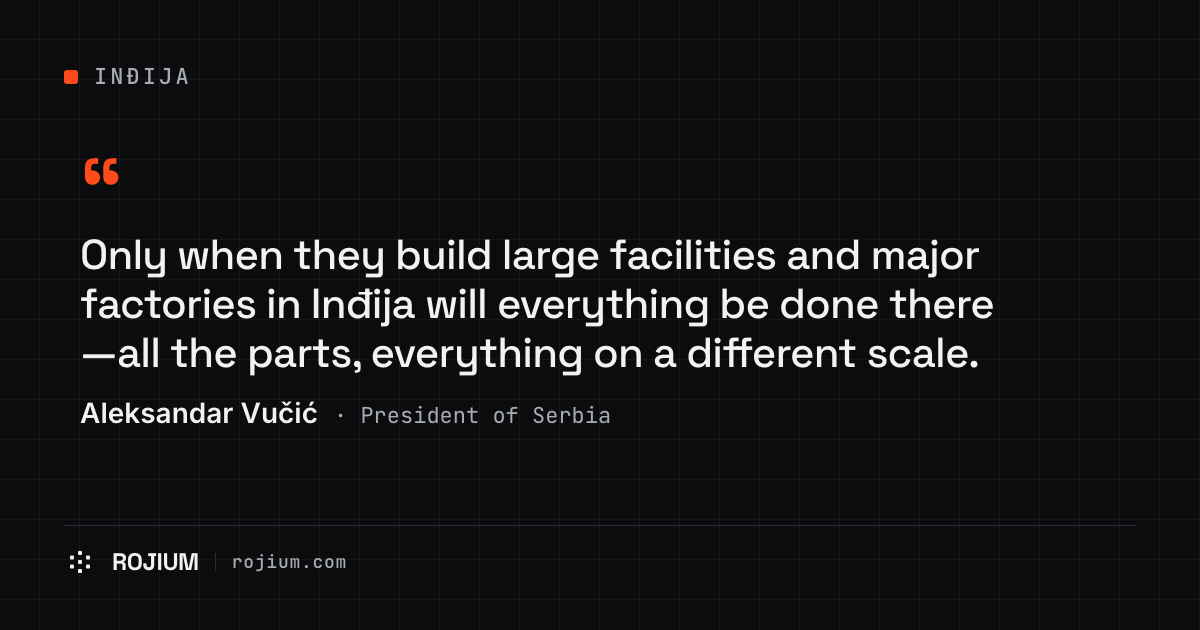
Around the Šabac plant: a park and a battery plant in Inđija, robot training in Kragujevac
Within two days of the Šabac opening, Serbia's robot project gained a €200m park and a €100.5m battery plant in Inđija and a robot-training centre in Kragujevac. So far only assembly is running.