ANYmal X starts shipping: what its Ex certificate covers
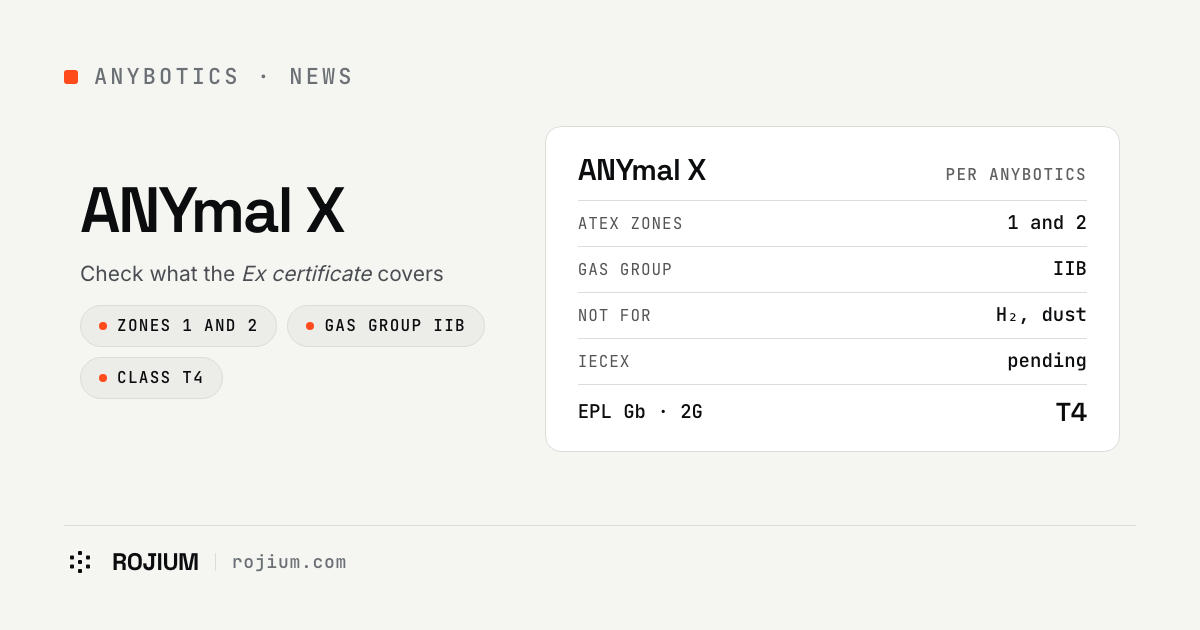
On 27 October ANYbotics said it had begun customer deliveries of ANYmal X, a four-legged inspection robot for explosive atmospheres, to oil, gas and chemical companies including Equinor and DSM-Firmenich. The company calls it the world's first legged inspection robot for such areas. For a buyer, “certified” is only the start: for which zone, which gas and under which scheme?
What the certificate covers
The announcement says the robot was “built to meet both standards”: ATEX, used in Europe, and the international IECEx. The product page is narrower: Bureau Veritas, a notified body, has issued an ATEX EU-type examination certificate, while IECEx certification “will be available with first production”, after an audit of the series production line.
| Limit | Per ANYbotics |
|---|---|
| Zones | 1 and 2 |
| Gas group, temperature class | IIB, T4 |
| Category, protection level | 2G, EPL Gb |
| Not intended for | Zone 0, explosive dust, group IIC gases such as hydrogen and acetylene |
| Charging, nitrogen refill | Outside the hazardous area |
Group IIB equipment also suits group IIA gases such as propane, but not IIC. T4 means a surface temperature of no more than 135 °C; compare it with the autoignition temperature of every substance on your site.
In June 2023 Bureau Veritas announced an Ex certification of ANYmal X that referred to IECEx and named no zone or gas group. The product page puts IECEx in the future. Before signing, ask for the number of every certificate that applies to your unit today.
What a zone is
Under Directive 1999/92/EC the employer divides places where explosive atmospheres may occur into zones. An explosion protection document must be drawn up before work starts and kept up to date.
| Zone | Explosive gas atmosphere | Equipment category |
|---|---|---|
| 0 | Present continuously, for long periods or frequently | 1 |
| 1 | Likely to occur occasionally in normal operation | 1 or 2 |
| 2 | Not likely in normal operation; if it occurs, only briefly | 1, 2 or 3 |
Dust has parallel Zones 20, 21 and 22. Category 2G equipment may be used in gas Zones 1 and 2, provided the gas group and temperature class also match.
ATEX and IECEx are not interchangeable
Directive 2014/34/EU governs placing such equipment on the EU market. For electrical Category 2 equipment, a notified body's examination of the type is followed by a second procedure covering production (Annex VI or VII). The manufacturer draws up an EU declaration of conformity and applies the CE and explosion-protection markings. Each product comes with a copy of the declaration or an attestation of conformity, and with instructions in a language end users easily understand, as the member state determines.
IECEx is a certification system governed by the IEC: a certificate rests on a tested sample plus a factory assessment and surveillance, and is listed in a public online database. The European Commission states that voluntary or additional certificates are not a recognised means of proving compliance under EU law, so on an EU site do not accept IECEx in place of the ATEX documents. For Serbia, confirm the national requirements with the supplier; we did not check them.
What to ask the seller
- CertificatesNumber, body, date and scheme, plus proof of the production procedure. Look up any IECEx number in the public database.
- Your zone mapDo zone, gas group and temperature class fit every point of the route?
- Dock and kitWhere outside the zone will the dock and nitrogen station stand? The product page lists an ATEX-rated control tablet as included and gas sensing as an option.
- Operating limits−10 to 50 °C, IP65 for the robot and IP67 for the payload, with temperature and IP ratings marked preliminary; more than 3 hours per charge.
Related: quadruped or humanoid in a warehouse and the EU machinery rules from 2027.
Sources
Turn the use case into a machine list.
Describe the site, payload and timeline. Rojium will map suitable hardware and service options.
Robot showcase
Compare the first catalogue machines.
Open the robot showcase to review pilots by vertical, use case and request-only commercial terms.
Related articles
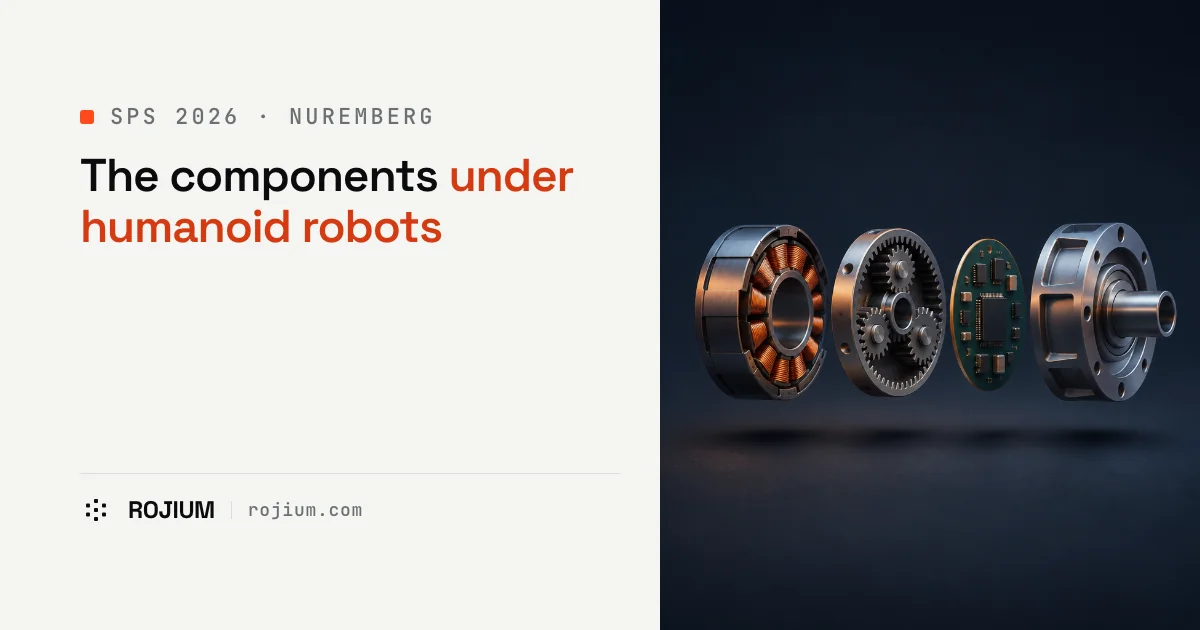
SPS 2026 in Nuremberg: the components under humanoid robots
Joint actuators from Neugart and Synapticon, a mobile humanoid showcase from Bosch Rexroth and chip demos: what suppliers announced for SPS 2026, and at what stage each item is.
The start date slips again: robot production now due end of August
On 13 July President Vučić moved the launch of humanoid-robot production in Šabac to the end of August, after the deal with the investor was finalised. It is the third date the project has been given.
Two months to robots: the July 15 timeline
From Beijing, Vučić put a date on it — humanoid-robot assembly to begin in Serbia by 15 July 2026, with 500 workers training in China and a starring role planned at Expo 2027.